JEE Advanced · Physics

Kinematics PYQs

20 previous-year questions from Kinematics in JEE Advanced, 2011–2026, latest first.

Q1JEE Advanced · 17 May 2026 · Paper-1One or more correct
A particle is thrown with a speed v from a point O at an angle θ with the horizontal plane such that it passes through the point P at a height of 1 m and horizontal distance of 5 m from O, as shown in the figure. If acceleration due to gravity is g m s−2, then the correct statement(s) is/are figure
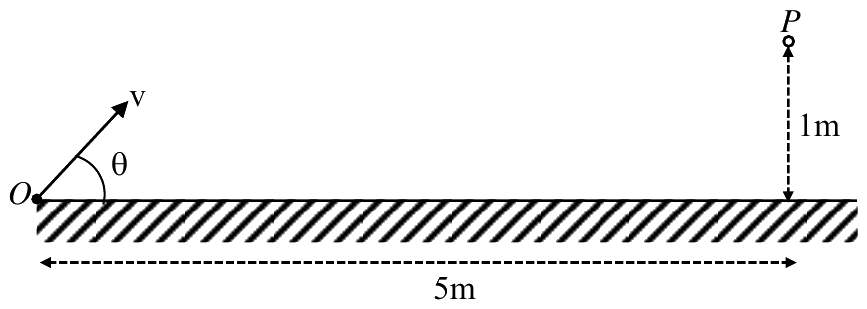
Question 1
  1. (A)If θ = 45∘{}^{∘\circ}, then v = 5g2\frac{5\sqrt{g}}{2} m s−1
  2. (B)If θ = 45∘{}^{∘\circ}, the particle reaches its maximum height before it reaches P
  3. (C)If θ = 30∘{}^{∘\circ}, the particle reaches its maximum height after reaching P
  4. (D)If θ = tan−1(1/5), then v = 125√√\surdg m s−1
Show answer & solution

Answer: A, B

Trajectory: 1 = 5 tan θ − 25g/(2v2cos2θ) θ = 45∘{}^{∘\circ}: 25g/v2 = 4 ⇒⇒\Rightarrow v = 5g2\frac{5\sqrt{g}}{2} m s−1 ✓; range R = v2/g = 6.25 m ⇒⇒\Rightarrow peak at R/2 = 3.125 m < 5 m ✓ θ = 30∘{}^{∘\circ}: R = 25/(5 − √√\surd3) ⇒⇒\Rightarrow R/2 ≈ 3.8 m < 5 m ⇒⇒\Rightarrow peak before P ✗ θ = tan−1(1/5): line OP has the same slope, so v →→\rightarrow ∞∞\infty ✗
Q2JEE Advanced · 18 May 2025 · Paper-2Numerical answer
A projectile of mass 200 g is launched in a viscous medium at an angle 60∘{}^{∘\circ} with the horizontal, with an initial velocity of 270 m/s. It experiences a viscous drag force F⃗ = −cv⃗ where the drag coefficient c = 0.1 kg/s and v⃗ is the instantaneous velocity of the projectile. The projectile hits a vertical wall after 2 s. Taking e = 2.7, the horizontal distance of the wall from the point of projection (in m) is ______.
Show answer & solution

Answer: 170

Horizontal:mdvxdt=−cvx⇒vx=v0xe−ct/m, with mc=0.20.1=2sHorizontal: m\frac{dv_{x}}{dt} = −cv_{x} \Rightarrow v_{x} = v_{0x}e^{−ct/m},\text{ with }\frac{m}{c} = \frac{0.2}{0.1} = 2 s x=v0xmc(1−e−ct/m)=270cos⁡60∘×2×(1−e−1)x = v_{0x}\frac{m}{c}(1 − e^{−ct/m}) = 270\cos 60{}^{\circ} \times 2 \times (1 − e^{−1}) x=270×(1−12.7)=270×1.72.7=170mx = 270 \times (1 − \frac{1}{2.7}) = 270 \times \frac{1.7}{2.7} = 170 m
Q3JEE Advanced · 26 May 2024 · Paper-2Numerical answer
A ball is thrown from the location (x0, y0) = (0, 0) of a horizontal playground with an initial speed v0 at an angle θ0 from the +x-direction. The ball is to be hit by a stone, which is thrown at the same time from the location (x1, y1) = (L, 0). The stone is thrown at an angle (180∘{}^{∘\circ} − θ1) from the +x-direction with a suitable initial speed. For a fixed v0, when (θ0, θ1) = (45∘{}^{∘\circ}, 45∘{}^{∘\circ}), the stone hits the ball after time T1, and when (θ0, θ1) = (60∘{}^{∘\circ}, 30∘{}^{∘\circ}), it hits the ball after time T2. In such a case, (T1/T2)2 is ______.
Show answer & solution

Answer: 2

Relative acceleration is zero, so the stone must have the same vertical velocity component as the ball. Case 1: v sin 45∘{}^{∘\circ} = v0 sin 45∘{}^{∘\circ} ⇒⇒\Rightarrow v = v0; T1 = L/(v0cos 45∘{}^{∘\circ} + v cos 45∘{}^{∘\circ}) = L/(√√\surd2 v0) Case 2: v sin 30∘{}^{∘\circ} = v0 sin 60∘{}^{∘\circ} ⇒⇒\Rightarrow v = √√\surd3v0; T2 = L/(v0/2 + 3v0/2) = L/(2v0) (T1/T2)2 = (2/√√\surd2)2 = 2

17 more Kinematics questions

Practise them free

Practise all 20 Kinematics PYQs

Untimed with solutions, or as a timed test. Your mistakes are saved so you can retry them.

Start free