JEE Advanced · Physics

Optics PYQs

71 previous-year questions from Optics in JEE Advanced, 2009–2026, latest first.

Q1JEE Advanced · 17 May 2026 · Paper-1
In the List-I, four optical effects are mentioned. The physical phenomena of light which are essential to describe these optical effects are given in List-II. Choose the option which describes the correct match between the entries in List-I to those in List-II.
List-I
List-II
(P)Colorful sky in north polar region (Aurora Borealis)(1)Dispersion and reflection
(Q)Partially polarized sun light(2)Total internal reflection
(R)Rainbow(3)Diffraction
(S)Dark and bright fringes(4)Scattering of light by molecules in the atmosphere
(5)Emission of radiation from oxygen and nitrogen atoms excited by charged particles
  1. (A)P →→\rightarrow 5, Q →→\rightarrow 4, R →→\rightarrow 1, S →→\rightarrow 3
  2. (B)P →→\rightarrow 4, Q →→\rightarrow 2, R →→\rightarrow 1, S →→\rightarrow 3
  3. (C)P →→\rightarrow 4, Q →→\rightarrow 1, R →→\rightarrow 2, S →→\rightarrow 3
  4. (D)P →→\rightarrow 5, Q →→\rightarrow 4, R →→\rightarrow 1, S →→\rightarrow 2
Show answer & solution

Answer: A

Aurora: emission from O and N excited by solar charged particles (5) Partial polarisation of skylight: scattering (4) Rainbow: dispersion and internal reflection in drops (1) Fringes: diffraction/interference (3)
Q2JEE Advanced · 17 May 2026 · Paper-2
A beam of polychromatic light passes through a thin prism of prism angle 6∘{}^{∘\circ}. The refractive index of the material of the prism varies with wavelength (λ) as n(λ) = αλ + β/λ2, where α = 3 μm−1 and β = 0.096 μm2. If λmin is the wavelength at which the angle of minimum deviation Dm is smallest, then the correct value of Dm at λmin is
  1. (A)6.4∘{}^{∘\circ}
  2. (B)4.8∘{}^{∘\circ}
  3. (C)3.2∘{}^{∘\circ}
  4. (D)2.4∘{}^{∘\circ}
Show answer & solution

Answer: B

δ = A(n − 1); dn/dλ = α − 2β/λ3 = 0 ⇒⇒\Rightarrow λ3 = 2β/α = 0.064 ⇒⇒\Rightarrow λ = 0.4 μm n = 1.2 + 0.6 = 1.8 ⇒⇒\Rightarrow Dm = 6∘{}^{∘\circ} ××\times 0.8 = 4.8∘{}^{∘\circ}
Q3JEE Advanced · 17 May 2026 · Paper-2One or more correct
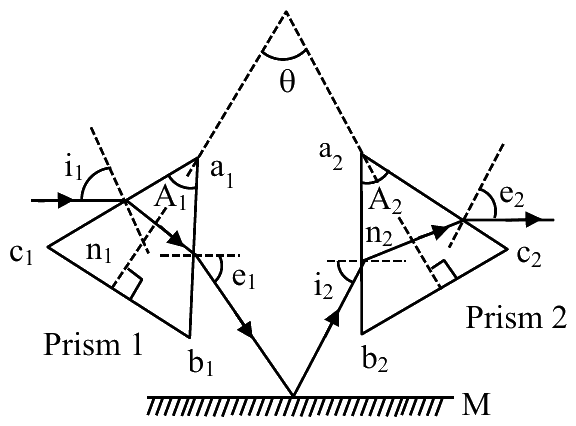
Consider two isosceles prisms 1 and 2 with prism angles A1 and A2 and refractive indices n1 and n2, respectively, as shown in the figure. The faces a1b1 and a2b2 are parallel to each other and perpendicular to the mirror M. If a ray of light is incident on the face a1c1 and emerges from the face a2c2, then the correct statement(s) is/are figure
Question 3
  1. (A)If both the prisms are at minimum deviation condition, then n2n1=sin⁡(A12)/sin⁡(A22)\frac{n_{2}}{n_{1}} = \sin (\frac{A_{1}}{2}) / \sin (\frac{A_{2}}{2})
  2. (B)If prism 2 is at minimum deviation condition, then sin i1 = n2 sin(A2/2) is always true
  3. (C)If both the prisms 1 and 2 are thin and are at minimum deviation condition with angles of deviation δm1 and δm2, respectively, then θ=δm12(n1−1)+δm22(n2−1)θ = \frac{δ_{m1}}{2(n_{1} − 1)} + \frac{δ_{m2}}{2(n_{2} − 1)}
  4. (D)If prism 1 is at minimum deviation condition, then sin i2 = n1 sin(A1/2) is always true
Show answer & solution

Answer: A, C, D

The mirror reflection with parallel faces makes e1 = i2 Both at minimum deviation: i1 = e1 = i2 = e2 ⇒⇒\Rightarrow n1 sin(A1/2) = n2 sin(A2/2) ✓ (A) Prism 1 at minimum deviation ⇒⇒\Rightarrow sin i2 = sin e1 = n1 sin(A1/2) ✓ (D); prism 2 alone does not fix i1 ✗ (B) θ = A1/2 + A2/2 with δm = (n − 1)A for thin prisms ✓ (C)

68 more Optics questions

Practise them free

Practise all 71 Optics PYQs

Untimed with solutions, or as a timed test. Your mistakes are saved so you can retry them.

Start free