Q1JEE Advanced · 27 Sept 2020 · Paper-2One or more correct
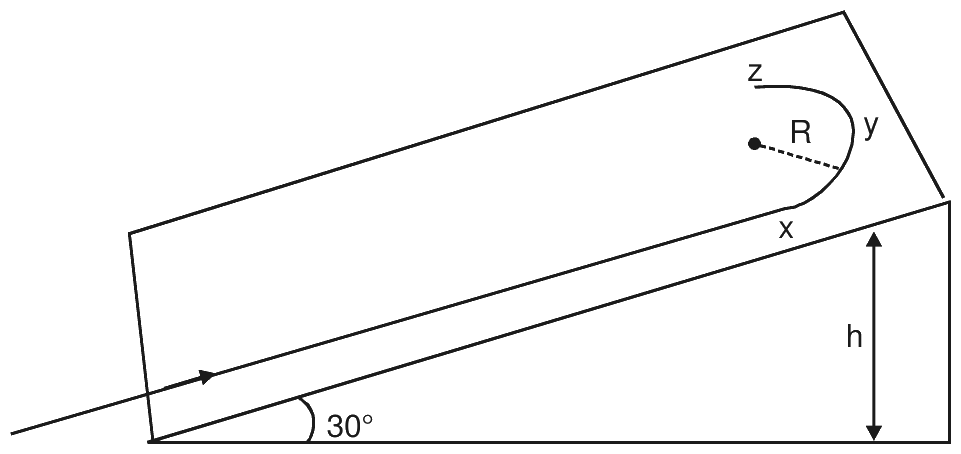
A student skates up a ramp that makes an angle 30 with the horizontal. He/she starts (as shown in the figure) at the bottom of the ramp with speed v0 and wants to turn around over a semicircular path xyz of radius R during which he/she reaches a maximum height h (at point y) from the ground as shown in the figure. Assume that the energy loss is negligible and the force required for this turn at the highest point is provided by his/her weight only. Then (g is the acceleration due to gravity)
- (A)
- (B)
- (C)the centripetal force required at points x and z is zero
- (D)the centripetal force required is maximum at points x and z
Show answer & solutionHide answer
Answer: A, D
Energy: vy2 = v02 − 2gh
At y the weight component along the incline provides the centripetal force: mg sin 30 = mvy2/R v02 − 2gh = gR/2 (A)
x and z are the lowest points of the turn, so speed (and hence mv2/R) is maximum there (D)
 The minimum value of ω0 below which the ring will drop down is