JEE Advanced · Physics

Center Of Mass, Momentum And Collision PYQs

15 previous-year questions from Center Of Mass, Momentum And Collision in JEE Advanced, 2009–2026, latest first.

Q1JEE Advanced · 17 May 2026 · Paper-2Numerical answer
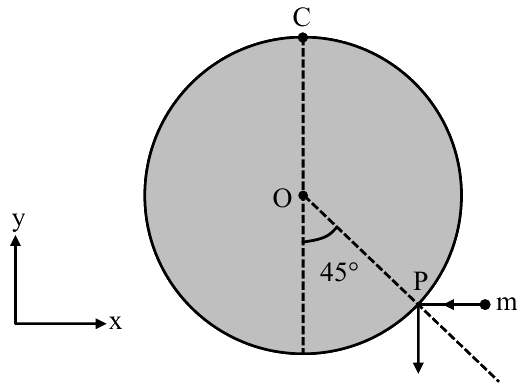
Question Stem (Questions 17–18) A uniform circular disk of radius 0.2 m and mass 1 kg is pivoted at its top point C such that it can rotate freely around C in the XY plane, as shown in the figure. Initially, when the disk is at rest, a particle of mass 20 g, travelling along negative x direction in the XY plane with speed 100 m s−1, hits the circumference of the disk at a point P. After collision the particle moves along negative y direction at a speed of 90 m s−1. [Given: the acceleration due to gravity (g) = −10 ĵ m s−2] figure Amount of energy loss (in J) in the collision is
Question 1
Show answer & solution

Answer: 17.47

Particle KE loss: (1/2)(0.02)(1002 − 902) = 19 J Disk gains (1/2)Iω2 ≈ 1.53 J ⇒⇒\Rightarrow loss ≈ 17.47 J
Q2JEE Advanced · 18 May 2025 · Paper-1
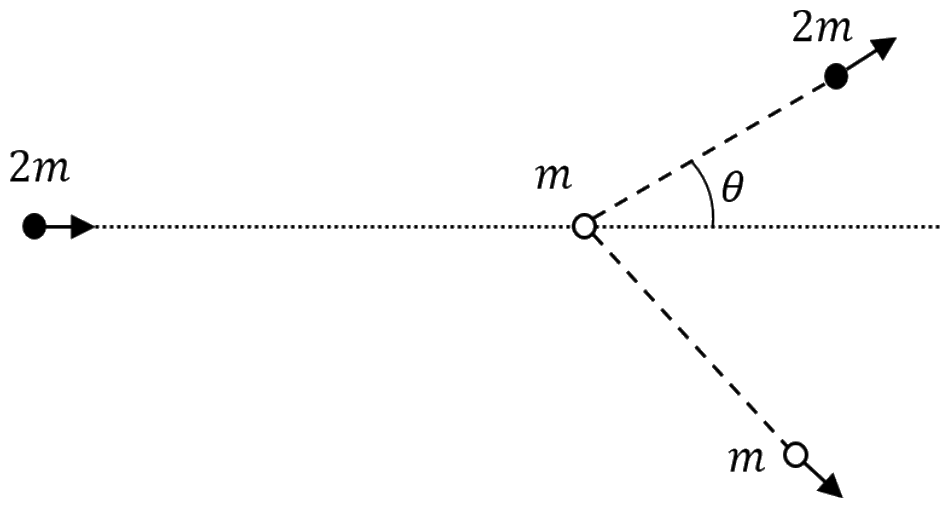
In a scattering experiment, a particle of mass 2m collides with another particle of mass m, which is initially at rest. Assuming the collision to be perfectly elastic, the maximum angular deviation θ of the heavier particle, as shown in the figure, in radians is: figure
Question 2
  1. (A)π
  2. (B)tan⁡−1(12)\tan ^{−1}(\frac{1}{2})
  3. (C)π3\frac{π}{3}
  4. (D)π6\frac{π}{6}
Show answer & solution

Answer: D

Momentum along x: 2mv1 = 2mv1fcos θ + mv2fcos φ … (i) Momentum along y: 2mv1fsin θ = mv2fsin φ … (ii) Energy:12(2m)v12=12(2m)v1f2+12mv2f2⇒2v12=2v1f2+v2f2…(iii)Energy: \frac{1}{2}(2m){v_{1}}^{2} = \frac{1}{2}(2m){v_{1f}}^{2} + \frac{1}{2}m{v_{2f}}^{2} \Rightarrow 2{v_{1}}^{2} = 2{v_{1f}}^{2} + {v_{2f}}^{2} … (iii) From (i), (ii), (iii): 3v1f2 − 4v1v1fcos θ + v12 = 0 For real v1f:(4v1cos⁡θ)2−4(3)v12≥0⇒cos⁡2θ≥34\text{For real v}_{1f}: (4v_{1}\cos θ)^{2} − 4(3){v_{1}}^{2} \geq 0 \Rightarrow \cos ^{2}θ \geq \frac{3}{4} ∴θmax=π6∴ θ_{max} = \frac{π}{6}
Q3JEE Advanced · 26 May 2024 · Paper-2Numerical answer
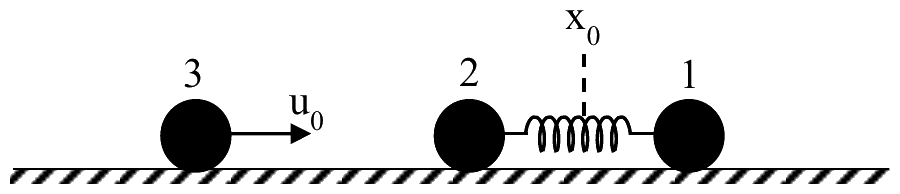
Paragraph II Two particles, 1 and 2, each of mass m, are connected by a massless spring, and are on a horizontal frictionless plane, as shown in the figure. Initially, the two particles, with their center of mass at x0, are oscillating with amplitude a and angular frequency ω. Thus, their positions at time t are given by x1(t) = (x0 + d) + a sin ωt and x2(t) = (x0 − d) − a sin ωt, respectively, where d > 2a. Particle 3 of mass m moves towards this system with speed u0 = aω/2, and undergoes instantaneous elastic collision with particle 2, at time t0. Finally, particles 1 and 2 acquire a center of mass speed vcm and oscillate with amplitude b and the same angular frequency ω. figure If the collision occurs at time t0 = 0, the value of vcm/(aω) will be ______.
Question 3
Show answer & solution

Answer: 0.75

At t = 0: particle 1 moves with +aω, particle 2 with −aω (towards particle 3). Elastic collision between equal masses exchanges velocities: particle 2 gets +aω/2. vcm=m(aω)+m(aω/2)2m=3aω4⇒vcmaω=0.75v_{cm} = \frac{m(aω) + m(aω/2)}{2m} = \frac{3aω}{4} \Rightarrow \frac{v_{cm}}{aω} = 0.75

12 more Center Of Mass, Momentum And Collision questions

Practise them free

Practise all 15 Center Of Mass, Momentum And Collision PYQs

Untimed with solutions, or as a timed test. Your mistakes are saved so you can retry them.

Start free