346 previous-year questions from Three Dimensional Geometry in JEE Main, 2013–2026, latest first.
Q1JEE Main · 8 Apr 2026 · Shift-II
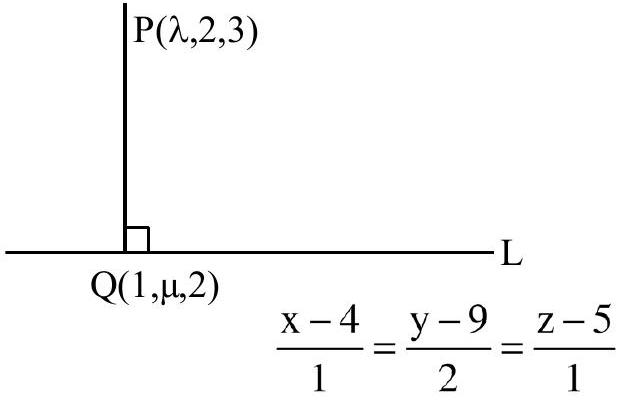
Let the foot of perpendicular from the point ( λ,2,3 ) on the line 1x−4=2y−9=1z−5 be the point (1,μ,2). Then the distance between the lines 2x−1=3y−2=6z+4 and 2x−λ=3y−μ=6z+5 is equal to
(A)712
(B)7145
(C)7146
(D)7143
Show answer & solutionHide answer
Answer: C
Q(1,μ,2) satisfies the line L
∴11−4=2μ−9=12−5⇒−3=2μ−9=−3⇒μ=3
D.R. of PQ:λ−1,2−μ,1
Since PQ⊥L⇒(λ−1).1+2(2−μ)+1.1=0⇒λ−2μ+4=0∴λ=2
Now lines : 2x−1=3y−2=6z+4 & 2x−2=3y−3=6z+5
i.e. r=(i^+2j^−4k^)+t1(2i^+3j^+6k^)
& r=(2i^+3j^−5k^)+t2(2i^+3j^+6k^)
Distance
=∣2i^+3j^+6k^∣∣((i^+2j^−4k^)−(2i^+3j^−5k^))×(2i^+3j^+6k^)∣=7∣−9i^+8j^−k^∣=7146
Q2JEE Main · 8 Apr 2026 · Shift-IINumerical answer
Let a line L1 pass through the origin and be perpendicular to the lines
L2:r=(3+t)i^+(2t−1)j^+(2t+4)k^ and L3:r=(3+2s)i^+(3+2s)j^+(2+s)k^,t,s∈R. If (a,b,c),a∈Z, is the point on L3 at a distance of 17 from the point of intersection of L1 and L2, then (a+b+c)2 is equal to ____.
Show answer & solutionHide answer
Answer: 4
L2:1x−3=2y+1=2z−4=tL3:2x−3=2y−3=1z−2=s
vector ⊥ar to L2 & L3⇒i12j22k21=i^(−2)−j^(−3)+k^(−2)⇒−2i^+3j^−2k^⇒−(2i^−3j^+2k^)Now,L1:2x=−3y=2z=ℓ
intersection of L1&L2⇒t+3=2ℓ,2t−1=−3ℓ,2t+4=2ℓt+3=2t+4t=−1⇒P≡(2,−3,2)
A point on L3 is Q(2s+3,2s+3,s+2)⇒PQ2=(2s+1)2+(2s+6)2+s2=17⇒9s2+28s+20=0⇒(9s+10)(s+2)=0⇒s=−2∴Q≡(−1,−1,0)≡(a,b,c)⇒(a+b+c)2=4
Q3JEE Main · 6 Apr 2026 · Shift-I
Let the image of the point P(1, 6, a) in the line L:1x=2y−1=bz−a+1,b>0, be (3a,0,a+c). If S(α,β,γ),α>0, is the point on L such that the distance of S from the foot of perpendicular from the point P on L is 214, then α+β+γ is equal to :
(A)19
(B)20
(C)21
(D)22
Show answer & solutionHide answer
Answer: C
Let Q be the point ⊥r from P(1,6,a) to the line L:1x=2y−1=bz−a+1
The image of point P in line L is P′(3a,0,a+c)
∵ Q is the mid point PP' :
Q≡(21+3a,26+0,2a+a+c)≡(63+a,3,22a+c)
comparing x and y, 63+a=1⇒a=3∴Q≡(1,3,26+c)
Direction vector of L is v=(1,2,b)
vector PQ is ⊥r to v∴PQ=(1−1,3−6,26+c−3)=(0,−3,2c)PQ⋅v=0(0).(1)+(−3)(2)+(2c)(b)=0bc=12
Now comparing z with Q (1,3, 26+c )
23−1=b26+c−3+12b−c=2
solving bc=12 and c=2b−2b=3,−2b=3(b>0)c=4∴Q(1,3,5)
Now, any point S on the line L can be written as (k, 2k + 1, 3k + 2)
SQ=(k−1)2+(2k−2)2+(3k−3)2=214k=3,−1
For k=3,S≡(3,7,11)∴α+β+γ=21
 satisfies the line L
D.R. of
Since
Now lines : &
i.e.
&
Distance