JEE Main · Mathematics

Complex Numbers PYQs

183 previous-year questions from Complex Numbers in JEE Main, 2013–2026, latest first.

Q1JEE Main · 8 Apr 2026 · Shift-II
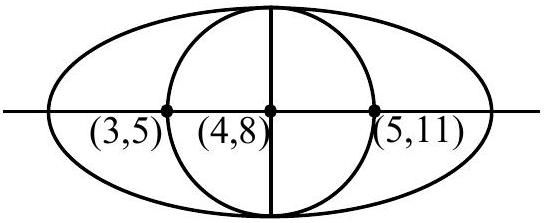
The number of values of z∈Cz\in C, satisfying the equations ∣z−(4+8i)∣=10|z−(4+8i)|=\sqrt{10} and ∣z−(3+5i)∣+∣z−(5+11i)∣=45|z−(3+5i)|+|z−(5+11i)|=4\sqrt{5}, is :
  1. (A)0
  2. (B)2
  3. (C)1
  4. (D)4
Show answer & solution

Answer: B

∣z−(3+5i)∣+∣z−(5+11i)∣=45|z−(3+5i)|+|z−(5+11i)|=4\sqrt{5} So, S1(3,5)S_{1}(3,5) & S2(5,11)S_{2}(5,11) are two foci of ellipse, where 2ae=S1S2=210&2a=452ae=S_{1}S_{2}=2\sqrt{10}\&2a=4\sqrt{5} ⇒a=25,e=12&b2=a2(1−e2) gives b2=10\Rightarrow a=2\sqrt{5},e=\frac{1}{\sqrt{2}} \& b^{2}=a^{2}\left(1−e^{2}\right)\text{ gives b}^{2}=10 & center of an ellipse is mid point of both focus ∴ center (4,8)(4,8) Equation of circle is ∣Z−(4+8i)∣=10|Z−(4+8i)|=\sqrt{10} ⇒⇒\Rightarrow Ellipse & given circle are concentric & radius of given circle is equal to length of minor axis of given ellipse figure ⇒⇒\Rightarrow Two points which are common to both.
Solution
Q2JEE Main · 6 Apr 2026 · Shift-I
Let the set of all values of k∈Rk\in R such that the equation z(z‾+2+i)+k(2+3i)=0,z∈Cz(\overline{z}+2+i)+k(2+3i)=0,z\in C, has at least one solution, be the interval [α,β][α,β]. Then 9(α+β)9(α+β) is equal to:
  1. (A)−10
  2. (B)−8
  3. (C)101310\sqrt{13}
  4. (D)8138\sqrt{13}
Show answer & solution

Answer: A

Put z=x+iy,z‾=x−iyz=x+iy,\overline{z}=x−iy ⇒z‾+2+i=x−iy+2+i⇒z(z‾+2+i)=(x+iy)(x+2+i(1−y))⇒ Real part =x(x+2)−y(1−y)\begin{matrix}& \Rightarrow \overline{z}+2+i=x−iy+2+i\\& \Rightarrow z(\overline{z}+2+i)=(x+iy)(x+2+i(1−y))\\& \Rightarrow \text{ Real part }=x(x+2)−y(1−y)\end{matrix} Imaginary part =x(1−y)+y(x+2)=x(1−y)+y(x+2) ⇒x2+y2+2x−y+2k=0   …(1)\begin{array}{c}\Rightarrow x^{2}+y^{2}+2x−y+2k=0   …(1)\end{array} and x+2y+3k=0   …(2)x+2y+3k=0   …(2) eliminating x from (1) and (2) 5y2+(12k−5)y+9k2−4k=05y^{2}+(12k−5)y+9k^{2}−4k=0 Since y∈Ry\in R  use D≥0(12k−5)2−4⋅5⋅(9k2−4k)≥0⇒36k2+40k−25≤0⇒α+β=−109⇒9(α+β)=−10\begin{matrix}&\text{ use }D\geq 0\\& (12k−5)^{2}−4\cdot 5\cdot \left(9k^{2}−4k\right)\geq 0\\& \Rightarrow 36k^{2}+40k−25\leq 0\\& \Rightarrow α+β=\frac{−10}{9}\\& \Rightarrow 9(α+β)=−10\end{matrix}
Q3JEE Main · 6 Apr 2026 · Shift-II
Let S={z∈C:z2+6iz−3=0}S=\left\{z\in C:z^{2}+\sqrt{6}iz−3=0\right\}. Then ∑z∈S z8\sum\limits_{z\in S}^{} z^{8} is equal to :
  1. (A)162
  2. (B)184
  3. (C)262
  4. (D)324
Show answer & solution

Answer: A

z=−6i±−6+122=−6i±62=62(±1−i)α=−62(1+i),β=62(1−i)α=−62×2eiπ/4,β=+62×2e−iπ/4α=−3eiπ/4,β=+3e−iπ/4α8+β8=81⋅ei2π+81⋅ei(−2π)=81(1+1)=162\begin{matrix}&z=\frac{−\sqrt{6}i\pm \sqrt{−6+12}}{2}\\& =\frac{−\sqrt{6}i\pm \sqrt{6}}{2}\\& =\frac{\sqrt{6}}{2}(\pm 1−i)\\&α=\frac{−\sqrt{6}}{2}(1+i),β=\frac{\sqrt{6}}{2}(1−i)\\&α=\frac{−\sqrt{6}}{2}\times \sqrt{2}e^{iπ/4},β=+\frac{\sqrt{6}}{2}\times \sqrt{2}e^{−iπ/4}\\&α=−\sqrt{3}e^{iπ/4},β=+\sqrt{3}e^{−iπ/4}\\&α^{8}+β^{8}=81⋅e^{i2π}+81⋅e^{i(−2π)}\\& =81(1+1)=162\end{matrix}

180 more Complex Numbers questions

Practise them free

Practise all 183 Complex Numbers PYQs

Untimed with solutions, or as a timed test. Your mistakes are saved so you can retry them.

Start free