JEE Main · Physics

Vectors PYQs

19 previous-year questions from Vectors in JEE Main, 2019–2021, latest first.

Q1JEE Main · 31 Aug 2021 · Shift-II
Statement I: Two forces (P⃗+Q⃗)\left(\vec{P}+\vec{Q}\right) and (P⃗−Q⃗)\left(\vec{P}−\vec{Q}\right) where P⃗⊥Q⃗\vec{P}\perp \vec{Q}, when act at an angle θ1 to each other, the magnitude of their resultant is 3(P2+Q2)\sqrt{3\left(P^{2}+Q^{2}\right)}, when they act at an angle θ2, the magnitude of their resultant becomes 2(P2+Q2)\sqrt{2\left(P^{2}+Q^{2}\right)}. This is possible only when θ1 < θ2. Statement II: In the situation given above, θ1 = 60∘{}^{∘\circ} and θ2 = 90∘{}^{∘\circ} In the light of the above statements, choose the most appropriate answer from the options given below
  1. (A)Statement-I is false but Statement-II is true
  2. (B)Both Statement-I and Statement-II are true
  3. (C)Statement-I is true but Statement-II is false
  4. (D)Both Statement-I and Statement-II are false.
Show answer & solution

Answer: B

Both forces have magnitude P2+Q2; resultant =2(P2+Q2)(1+cos⁡θ)\text{Both forces have magnitude }\sqrt{P^{2}+Q^{2}};\text{ resultant }= \sqrt{2\left(P^{2}+Q^{2}\right)\left(1+\cos θ\right)} Resultant 3(P2+Q2)⇒cos⁡θ1=12,θ1=60∘;2(P2+Q2)⇒θ2=90∘. Both statements are true.\text{Resultant }\sqrt{3\left(P^{2}+Q^{2}\right)} \Rightarrow \cos θ1 = \frac{1}{2}, θ1 = 60{}^{\circ} ; \sqrt{2\left(P^{2}+Q^{2}\right)} \Rightarrow θ2 = 90{}^{\circ} .\text{ Both statements are true}.
Q2JEE Main · 27 Aug 2021 · Shift-I
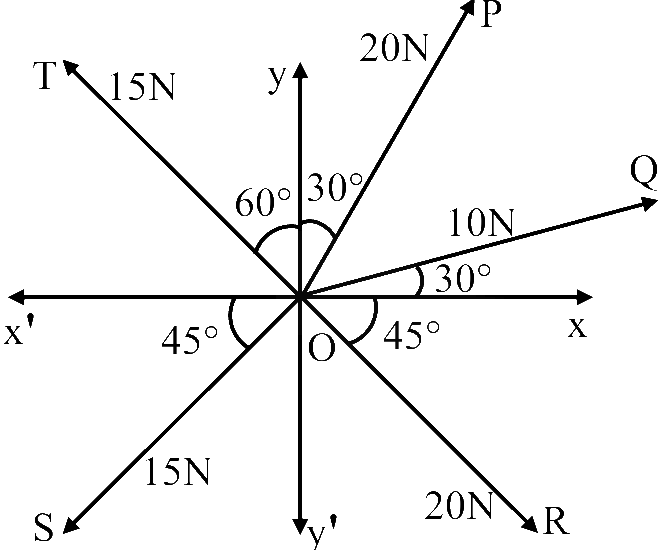
The resultant of these forces OP⃗\vec{OP}, OQ⃗\vec{OQ}, OR⃗\vec{OR}, OS⃗\vec{OS} and OT⃗\vec{OT} is approximately ______ N. [Take 3\sqrt{3} = 1.7, 2\sqrt{2} = 1.4. Given i^\hat{i} and j^\hat{j} unit vectors along x, y axis] figure
Question 2
  1. (A)9.25i^+5j^9.25\hat{i}+5\hat{j}
  2. (B)3i^+15j^3\hat{i}+15\hat{j}
  3. (C)2.5i^−14.5j^2.5\hat{i}−14.5\hat{j}
  4. (D)−1.5i^−15.5j^−1.5\hat{i}−15.5\hat{j}
Show answer & solution

Answer: A

Fx = 10 cos 30∘{}^{∘\circ} + 20 sin 30∘{}^{∘\circ} + 20 cos 45∘{}^{∘\circ} – 15 cos 45∘{}^{∘\circ} – 15 sin 60∘{}^{∘\circ} = 8.5 + 10 + 14 – 10.5 – 12.75 = 9.25 Fy = 15 cos 60∘{}^{∘\circ} + 20 cos 30∘{}^{∘\circ} + 10 sin 30∘{}^{∘\circ} – 15 sin 45∘{}^{∘\circ} – 20 sin 45∘{}^{∘\circ} = 7.5 + 17 + 5 – 10.5 – 14 = 5 Resultant ≈ 9.25i^+5j^9.25\hat{i}+5\hat{j}
Q3JEE Main · 26 Aug 2021 · Shift-I
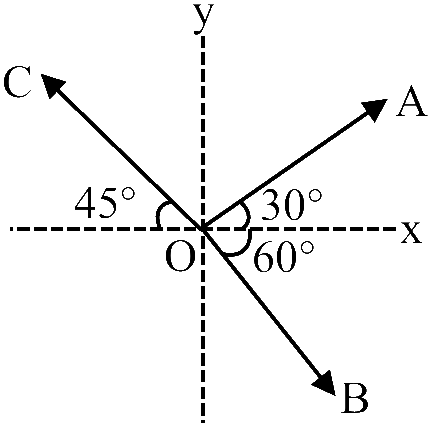
The magnitude of vectors OA⃗\vec{OA}, OB⃗\vec{OB} and OC⃗\vec{OC} in the given figure are equal. The direction of OA⃗+OB⃗−OC⃗\vec{OA}+\vec{OB}−\vec{OC} with x-axis will be figure
Question 3
  1. (A)tan⁡−1(1−3−2)(1+3+2)\tan ^{−1}\frac{\left(1−\sqrt{3}−\sqrt{2}\right)}{\left(1+\sqrt{3}+\sqrt{2}\right)}
  2. (B)tan⁡−1(3−1+2)(1+3−2)\tan ^{−1}\frac{\left(\sqrt{3}−1+\sqrt{2}\right)}{\left(1+\sqrt{3}−\sqrt{2}\right)}
  3. (C)tan⁡−1(3−1+2)(1−3+2)\tan ^{−1}\frac{\left(\sqrt{3}−1+\sqrt{2}\right)}{\left(1−\sqrt{3}+\sqrt{2}\right)}
  4. (D)tan⁡−1(1+3−2)(1−3−2)\tan ^{−1}\frac{\left(1+\sqrt{3}−\sqrt{2}\right)}{\left(1−\sqrt{3}−\sqrt{2}\right)}
Show answer & solution

Answer: A

OA⃗=λ(32i^+12j^),OB⃗=λ(12i^−32j^),OC⃗=λ(−12i^+12j^) \vec{OA}=λ\left(\frac{\sqrt{3}}{2}\hat{i}+\frac{1}{2}\hat{j}\right), \vec{OB}=λ\left(\frac{1}{2}\hat{i}−\frac{\sqrt{3}}{2}\hat{j}\right), \vec{OC}=λ\left(−\frac{1}{\sqrt{2}}\hat{i}+\frac{1}{\sqrt{2}}\hat{j}\right) OA⃗+OB⃗−OC⃗=λ[(3+12+12)i^+(1−32−12)j^]\vec{OA}+\vec{OB}−\vec{OC}=λ\left[\left(\frac{\sqrt{3}+1}{2}+\frac{1}{\sqrt{2}}\right)\hat{i}+\left(\frac{1−\sqrt{3}}{2}−\frac{1}{\sqrt{2}}\right)\hat{j}\right] Angle with x−axis =tan⁡−11−3−21+3+2\text{Angle with x}-\text{axis }= \tan ^{−1}\frac{1−\sqrt{3}−\sqrt{2}}{1+\sqrt{3}+\sqrt{2}}

16 more Vectors questions

Practise them free

Practise all 19 Vectors PYQs

Untimed with solutions, or as a timed test. Your mistakes are saved so you can retry them.

Start free