JEE Main · Chemistry

Chemical Thermodynamics PYQs

186 previous-year questions from Chemical Thermodynamics in JEE Main, 2013–2026, latest first.

Q1JEE Main · 8 Apr 2026 · Shift-IINumerical answer
Consider the reaction : 2H2S(g)+3O2(g)→2H2O(l)+2SO2(g)2H_{2} S( g)+3O_{2}( g)\rightarrow 2H_{2}O(l)+2SO_{2}( g) The magnitude of enthalpy change for the reaction in kJmol−1kJmol^{−1} is ____. (Nearest integer) Given : ΔfH⊖(H2S)=−20.1 kJ mol−1Δ_{f}H^{⊖}\left(H_{2} S\right)=−20.1\text{ kJ mol}^{−1} ΔfHΘ(H2O)=−286.0 kJ mol−1ΔfHΘ(SO2)=−297.0 kJ mol−1\begin{matrix}Δ_{f}H^{Θ}\left(H_{2}O\right)=−286.0\text{ kJ mol}^{−1}\\Δ_{f}H^{Θ}\left(SO_{2}\right)=−297.0\text{ kJ mol}^{−1}\end{matrix}
Show answer & solution

Answer: 1126

ΔrH∘=ΣΔHf∘( product )−ΣΔHf∘( Reactant )ΔrH∘=2×ΔHf∘(SO2,g)+2×ΔHf∘(H2O,ℓ)−2×ΔHf∘(H2S,g)\begin{matrix}&Δ_{r}H^{∘}=ΣΔH_{f}^{∘}(\text{ product })−ΣΔH_{f}^{∘}(\text{ Reactant })\\&Δ_{r}H^{∘}=2\times ΔH_{f}^{∘}\left(SO_{2}, g\right)+2\times ΔH_{f}^{∘}\left(H_{2}O,ℓ\right)\\& −2\times ΔH_{f}^{∘}\left(H_{2} S, g\right)\end{matrix} ΔrH∘=2×(−297)+2×(−286)−2(−20.1)=−594−572+40.2ΔrH∘=−1125.8kJ/mol.∣ΔrH∘∣=1125.8kJ/mol.\begin{matrix}&Δ_{r}H^{∘}=2\times (−297)+2\times (−286)−2(−20.1)\\& =−594−572+40.2\\&Δ_{r}H^{∘}=−1125.8 kJ/mol.\\&\left|Δ_{r}H^{∘}\right|=1125.8 kJ/mol.\end{matrix}
Q2JEE Main · 6 Apr 2026 · Shift-I
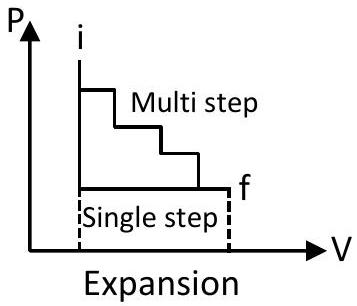
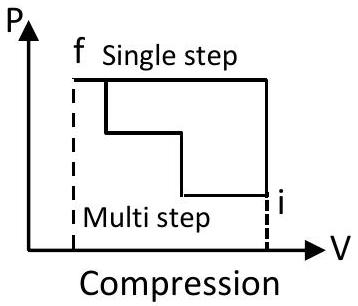
Arrange the following isothermal processes in order of the magnitude of the work (p - V) involved between states 1 and 2. A. Expansion in single stage wAw_{A} B. Expansion in multi stages wBw_{B} C. Compression in single stage wCw_{C} D. Compression in multi stages wDw_{D}
  1. (A)∣wB∣>∣wA∣>∣wC∣>∣wD∣\left|w_{B}\right|>\left|w_{A}\right|>\left|w_{C}\right|>\left|w_{D}\right|
  2. (B)∣wC∣>∣wD∣>∣wA∣>∣wB∣\left|w_{C}\right|>\left|w_{D}\right|>\left|w_{A}\right|>\left|w_{B}\right|
  3. (C)∣wC∣>∣wD∣>∣wB∣>∣wA∣\left|w_{C}\right|>\left|w_{D}\right|>\left|w_{B}\right|>\left|w_{A}\right|
  4. (D)∣wB∣>∣wA∣>∣wD∣>∣wC∣\left|w_{B}\right|>\left|w_{A}\right|>\left|w_{D}\right|>\left|w_{C}\right|
Show answer & solution

Answer: C

figure figure ∴∣wA∣<∣wB∣<∣wD∣<∣wC∣∴\left|w_{A}\right|<\left|w_{B}\right|<\left|w_{D}\right|<\left|w_{C}\right|
SolutionSolution
Q3JEE Main · 6 Apr 2026 · Shift-II
Match List-I with List-II Given V1V_{1} and V2V_{2} are initial and final volumes respectively:
List-I
(Isothermal process)
List-II
(Expression)
A.Reversible expansionI.q=0q=0
B.Free expansionII.q=nRTln⁡V2V1q=nRT\ln \frac{V_{2}}{ V_{1}}
C.Irreversible CompressionIII.w=−pext (V1−V2)w=−p_{\text{ext }}\left(V_{1}−V_{2}\right)
D.Cyclic reversibleIV.qrev T=0\frac{q_{\text{rev }}}{T}=0
Choose the correct answer from the options given below :
  1. (A)A-II, B-III, C-I, D-IV
  2. (B)A-II, B-I, C-IV, D-III
  3. (C)A-II, B-I, C-III, D-IV
  4. (D)A-I, B-II, C-III, D-IV
Show answer & solution

Answer: C

(A) For isothermal process, ΔU=0ΔU=0 W=−nRTℓn(V2V1) so q=nRTℓn(V2V1)W=−nRTℓn\left(\frac{ V_{2}}{ V_{1}}\right)\text{ so }q=nRTℓn\left(\frac{ V_{2}}{ V_{1}}\right) (B) Free expansion which is isothermal must be adiabatic, so q=0q=0 (C) Irreversible process W=−Pext [V2−V1]W=−P_{\text{ext }}\left[V_{2}−V_{1}\right] (D) Cyclic process, change in state function (S) so change in entropy must be zero. dS=dqrevT∮dS=0\begin{matrix}&dS=\frac{dq_{rev}}{ T}\\&∮ dS=0\end{matrix}

183 more Chemical Thermodynamics questions

Practise them free

Practise all 186 Chemical Thermodynamics PYQs

Untimed with solutions, or as a timed test. Your mistakes are saved so you can retry them.

Start free