Q1JEE Advanced · 17 May 2026 · Paper-1
Match each entry in List-I to the correct entry in List-II and choose the correct option.
List-I | List-II | ||
| (P) | The circle with centre (1, 2) and touching the straight line 3x + 4y = 1, passes through | (1) | the point (1, 1) |
| (Q) | The common tangent to the circle x2 + y2 = 2 and the parabola y2 = 8x with positive slope, passes through | (2) | the point (7, 9) |
| (R) | Let M be the end point of the latus rectum of the ellipse 3x2 + 4y2 = 48 such that M lies in the first quadrant. Then the normal to the ellipse drawn at M passes through | (3) | the point (3, 2) |
| (S) | Let H be the hyperbola whose centre is at the origin, one of the foci is at (5, 0), and one directrix is 5x + 16 = 0. Then H passes through | (4) | the point (2, 5) |
| (5) | the point |
- (A)P 3, Q 4, R 1, S 2
- (B)P 3, Q 2, R 1, S 5
- (C)P 3, Q 2, R 4, S 5
- (D)P 4, Q 1, R 2, S 3
Show answer & solutionHide answer
Answer: B
(P) 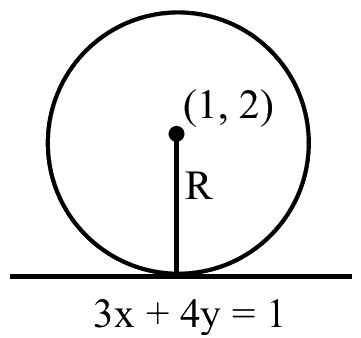 R = distance from (1, 2) to the line circle ; the point (3, 2) satisfies it P 3
(Q) Tangent to ; also tangent to m = 1 (positive slope)
Tangent: y = x + 2, which passes through (7, 9) Q 2
(R)
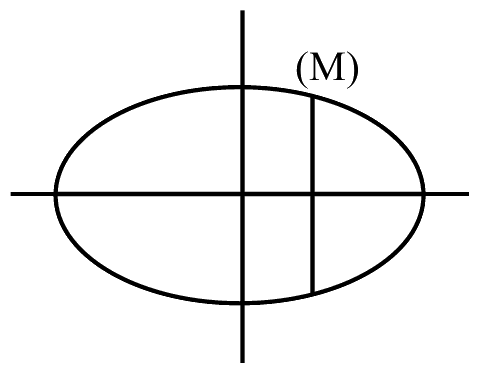 Normal at (2, 3): , which passes through (1, 1) R 1
(S)
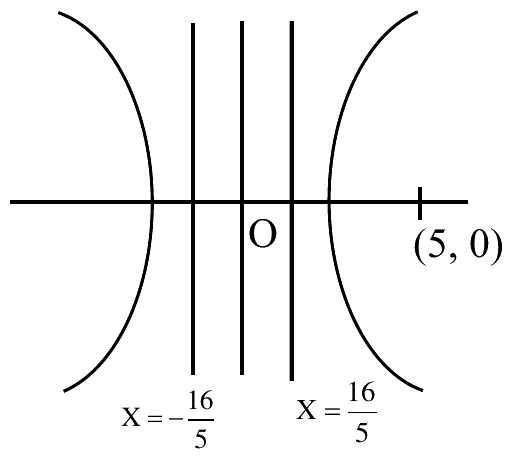 ae = 5 and , which passes through (8, 33) S 5
R = distance from (1, 2) to the line circle ; the point (3, 2) satisfies it P 3
(Q) Tangent to ; also tangent to m = 1 (positive slope)
Tangent: y = x + 2, which passes through (7, 9) Q 2
(R)
Normal at (2, 3): , which passes through (1, 1) R 1
(S)
ae = 5 and , which passes through (8, 33) S 5