JEE Advanced · Mathematics

Area Under The Curve PYQs

17 previous-year questions from Area Under The Curve in JEE Advanced, 2009–2026, latest first.

Q1JEE Advanced · 17 May 2026 · Paper-2Numerical answer
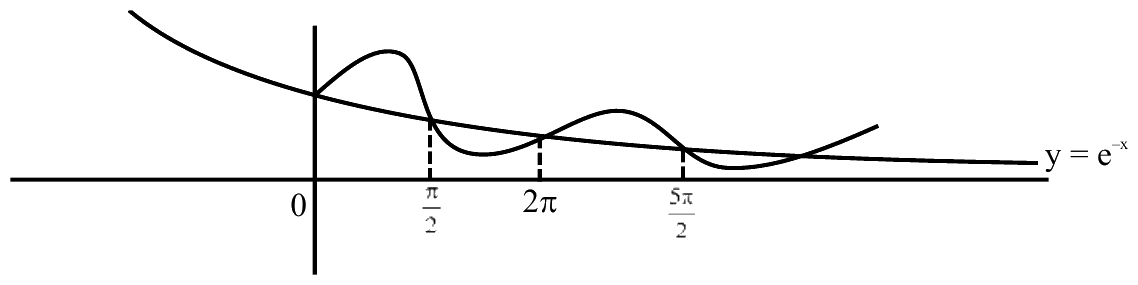
Question Stem for Question Nos. 15 and 16 Consider the curve C1 given by y = e−x for x ∈∈\in [0, 10π], and the curve C2 given by y = e−x(sin x + cos x) for x ∈∈\in [0, 10π]. Let n be the total number of points of intersection of the curves C1 and C2. Suppose that α1, α2, …, αn ∈∈\in [0, 10π] are the x-coordinates of the points of intersection of the curves C1 and C2 such that α1 < α2 < … < αn. Let β be the area of the region enclosed between the curves C1,C2,C_{1}, C_{2}, and the lines x=α1x = α_{1} and x=α4.x = α_{4}. Then the value of −1πlog⁡e(β−2e−π/2)−\frac{1}{π}\log _{e}(β − 2e^{−π/2}) is _________.
Show answer & solution

Answer: 2.5

α1=0α_{1} = 0 and α4=5π2α_{4} = \frac{5π}{2} figure β=∫05π/2∣e−x(sin⁡x+cos⁡x)−e−x∣dxβ = \int_{0}^{5π/2}|e^{−x}(\sin x + \cos x) − e^{−x}|dx, split at π/2 and 2π where the curves cross: β=∫0π/2(e−x(sin⁡x+cos⁡x)−e−x)dxβ = \int_{0}^{π/2}(e^{−x}(\sin x + \cos x) − e^{−x})dx +∫π/22π(e−x−e−x(sin⁡x+cos⁡x))dx+ \int_{π/2}^{2π}(e^{−x} − e^{−x}(\sin x + \cos x))dx +∫2π5π/2(e−x(sin⁡x+cos⁡x)−e−x)dx+ \int_{2π}^{5π/2}(e^{−x}(\sin x + \cos x) − e^{−x})dx Using ∫e−x(sin⁡x+cos⁡x)dx=−e−xcos⁡x:β\int_{}^{} e^{−x}(\sin x + \cos x)dx = −e^{−x}\cos x: β =2e−π/2+e−5π/2= 2e^{−π/2} + e^{−5π/2} −1πlog⁡(β−2e−π/2)=−1π(−5π2)=52=2.50−\frac{1}{π}\log (β − 2e^{−π/2}) = −\frac{1}{π}(−\frac{5π}{2}) = \frac{5}{2} = 2.50
Solution
Q2JEE Advanced · 17 May 2026 · Paper-2Numerical answer
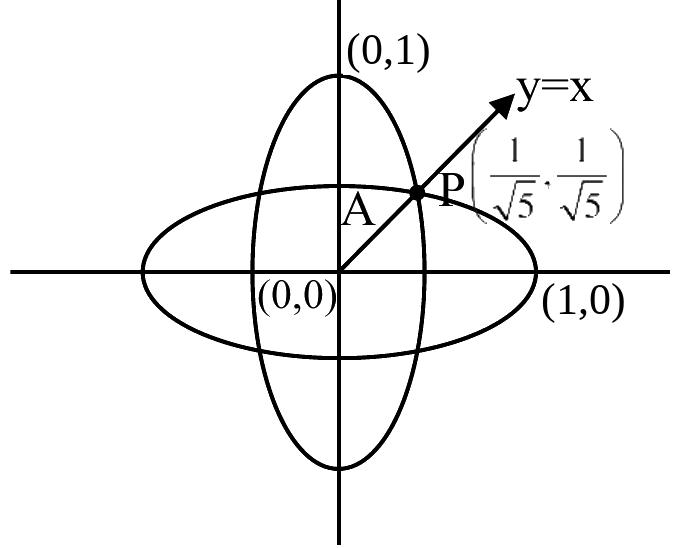
Question Stem for Question Nos. 17 and 18 Consider the ellipses given by x2 + 4y2 = 1 and 4x2 + y2 = 1. If α is the area of the common region that lies inside both the given ellipses, then the value of cot α is ___________.
Show answer & solution

Answer: 0.75

figure A=∫01/5(1−x22−x)dxA = \int_{0}^{1/\sqrt{5}}(\frac{\sqrt{1 − x^{2}}}{2} − x)dx; by symmetry the total required area α = 8A α=8[x41−x2+14sin⁡−1x−x22]01/5α = 8[\frac{x}{4}\sqrt{1 − x^{2}} + \frac{1}{4}\sin ^{−1}x − \frac{x^{2}}{2}{]_{0}}^{1/\sqrt{5}} =8[14545+14sin⁡−115−110]= 8[\frac{1}{4\sqrt{5}}\sqrt{\frac{4}{5}} + \frac{1}{4}\sin ^{−1}\frac{1}{\sqrt{5}} − \frac{1}{10}] α=2sin⁡−115=2tan⁡−112=tan⁡−1(2×121−14)α = 2\sin ^{−1}\frac{1}{\sqrt{5}} = 2\tan ^{−1}\frac{1}{2} = \tan ^{−1}(\frac{2 \times \frac{1}{2}}{1 − \frac{1}{4}}) =tan⁡−1(43)= \tan ^{−1}(\frac{4}{3}) cot⁡α=34=0.75\cot α = \frac{3}{4} = 0.75
Solution
Q3JEE Advanced · 18 May 2025 · Paper-2
Let ℝ denote the set of all real numbers. Then the area of the region {(x, y) ∈∈\in ℝ ××\times ℝ : x > 0, y > 1/x, 5x − 4y − 1 > 0, 4x + 4y − 17 < 0} is
  1. (A)1716−log⁡e4\frac{17}{16} − \log _{e}4
  2. (B)338−log⁡e4\frac{33}{8} − \log _{e}4
  3. (C)578−log⁡e4\frac{57}{8} − \log _{e}4
  4. (D)172−log⁡e4\frac{17}{2} − \log _{e}4
Show answer & solution

Answer: B

Intersections: 5x − 4y = 1 and 4x + 4y = 17 meet at (2, 9/4); y = 1/x meets 5x − 4y = 1 at (1, 1) and 4x + 4y = 17 at (4, 1/4). Area =∫125x−14dx+∫2417−4x4dx−∫141xdx\text{Area }= \int_{1}^{2}\frac{5x − 1}{4}dx + \int_{2}^{4}\frac{17 − 4x}{4}dx − \int_{1}^{4}\frac{1}{x}dx =138+208−log⁡e4=338−log⁡e4= \frac{13}{8} + \frac{20}{8} − \log _{e}4 = \frac{33}{8} − \log _{e}4

14 more Area Under The Curve questions

Practise them free

Practise all 17 Area Under The Curve PYQs

Untimed with solutions, or as a timed test. Your mistakes are saved so you can retry them.

Start free